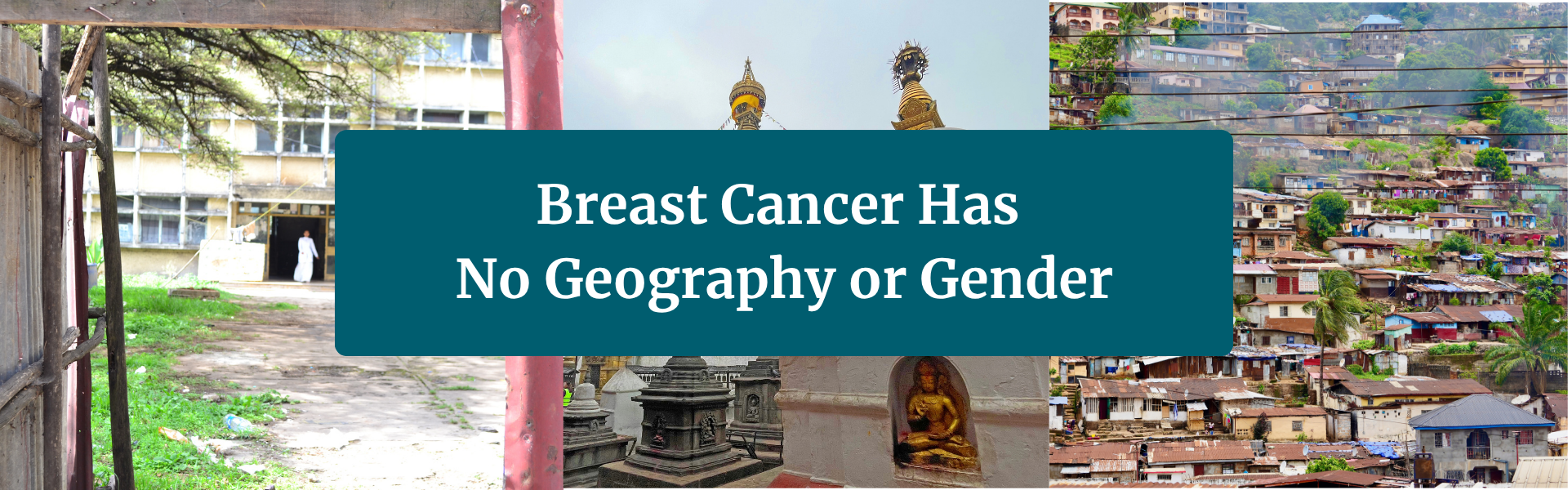
Breast Cancer Has No Geography or Gender
Across low-resource countries, the story for women with breast cancer sounds sadly familiar: the diagnosis is late, often due largely to stigma.
For men in many of these settings, the diagnosis is simply unheard of. As one patient told Dr. Guru Sharan Sah, a medical partner oncologist of The Max Foundation (Max) at B.P. Koirala Memorial Cancer Hospital in Nepal:
“There must be some mistake doctor. Men don’t get breast cancer.”
Dr. Guru has sat across from patients like this far too often. Men who arrived late by months, sometimes years, after first noticing a lump, because no one around them had ever told them it was possible.
That is starting to change. In 2022, Max launched its Humanitarian Partnership for Access to Critical Treatment (PACT) for breast cancer care. Since then, around 1,400 patients have initiated treatment in more than 19 countries. While women are among the vast majority of patients, six men are also benefitting from treatment and support. In fact, the first breast cancer patient approved in our Sierra Leone program this year was male.
A Structural Change
Because male breast cancer is uncommon, the treatment options are not the same. They don’t have the same breast tissue, which makes surgery more complicated. Medical teams aim to bring male breast cancer under control another way, like targeted therapy options available through our partnerships.
“Male breast cancer is rare, accounting for roughly 1% of all breast cancers globally,” Dr. Guru said. “In Nepal, where awareness is already stretched thin and resources thinner still, rarity translates into invisibility. Campaigns do not reach these patients. Screening pathways are not designed for them. And when the disease crosses into metastatic territory, the conversation becomes particularly painful.”
That’s because patients previously had access to only one of the two types of medicine required to properly address their disease. They had to pay for the other out of pocket, some of them doing so by selling assets and borrowing from family. Those who couldn’t sustain it had to stop. Not because the drug stopped working, but because the cost was too high.
Dr. Guru said things are changing now that patients have access to medicine, diagnostics, and support services thanks to Max’s Humanitarian PACT for breast cancer care.
“The Max Foundation has given us the other half of the regimen and with it, the ability to offer the full combination that the data supports,” he said. “That is a profound shift in what we can do for these patients.”
Equity in the Form of a Tablet
Initially, in countries like Jamaica and Nepal, the Max breast cancer program was designed exclusively for women. This year it was modified to also include men, acknowledging that breast cancer is not a gendered disease. The stigma that delays men from seeking a diagnosis is partly built on silence, including:
- The unspoken assumption that this could not happen to a man
- The absence of men in awareness campaigns
- The absence of care pathways for men within health care systems
Male breast cancer is rare, but not unimportant. Max staff and partner physicians around the world know that no patient should be left behind because of their gender, their income, their location, or their diagnosis.
“I want everyone to know that breast cancer is not only a woman’s disease,” said Purna, the second man in Nepal to receive treatment through our program. “Men can get breast cancer too. Please don’t ignore a lump or any unusual change. Early diagnosis can save lives.”