Solidarity Fund Celebrates First Delivery

Solidarity Fund Celebrates First Delivery

Earlier this month, The Max Foundation celebrated the delivery of 110 BCR-ABL molecular tests to Mercy Medical Center Cambodia. The delivery was the first of its kind for Max, made possible through our 2018 Diagnostics Solidarity Fund. Two more deliveries – one to Kyrgyzstan and one to Bolivia – are in process now, and we’re hopeful there will be many more to come.

Why are BCR-ABL molecular tests important?

Before a patient can be treated, he or she must first be diagnosed. A simple concept to be sure, but with a disease like chronic myeloid leukemia (CML), diagnosis isn’t that simple.

In order to accurately diagnose CML and monitor a patient’s ongoing treatment, molecular testing is required to determine the presence and prevalence of the mutated BCR-ABL protein. However, in the low- and middle-income countries where we work, molecular testing is often unavailable or prohibitively expensive.

Bridging Gaps in Access

To help bridge that gap for patients, we established the 2018 Diagnostics Solidarity Fund – a donation program dedicated to increasing access to molecular testing in 22 resource-challenged countries. Specifically, the fund enables The Max Foundation to donate up to 3,600 BCR-ABL molecular tests to qualifying institutions.

Each one of the 110 tests delivered to Mercy Medical Center Cambodia represents an opportunity – either for a new patient to gain access to life-saving treatment, or, for an existing patient to improve his or her disease outcome. Those are opportunities worth celebrating.

Special Thanks

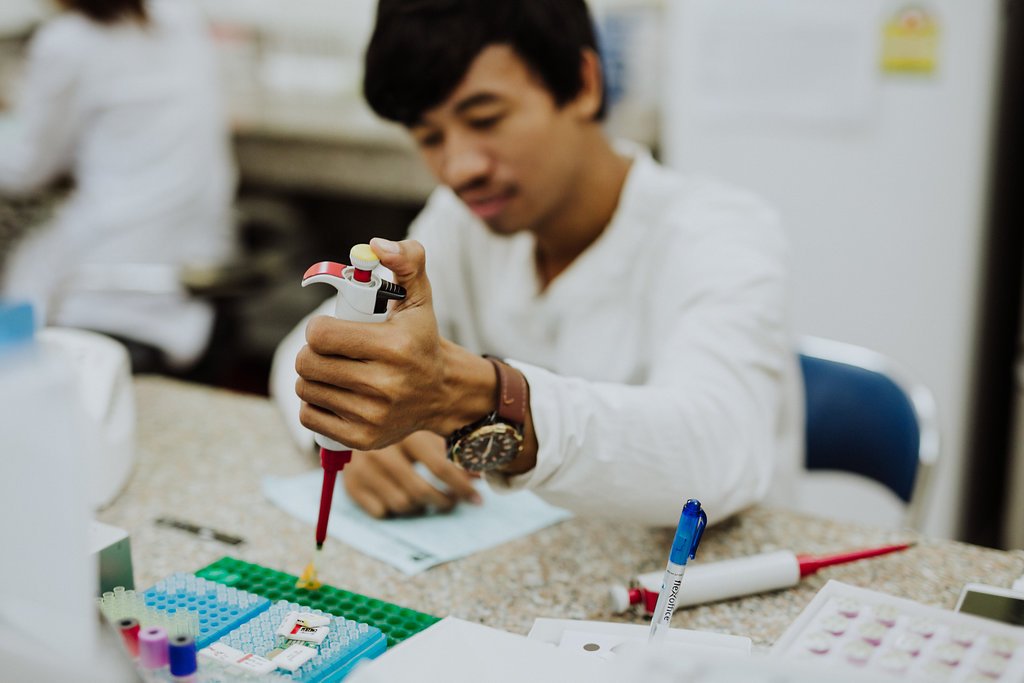
We offer our heartfelt thanks and appreciation to the CML/GIST team at Mercy Medical Cambodia: Drs. Tim Benadum, Mary Kluck, Inge Mathes, and Alan Norman, as well as head administrator Sovatdy Sanh, and laboratory technicians Kanhara Im and Saora Toeur (pictured). They go above and beyond for their patients each and every day and it’s an honor to support their efforts.

The Max Foundation is a leading global health nonprofit organization dedicated to accelerating health equity. For 28 years, Max has pioneered practical, scalable, high-quality solutions to bring life-extending treatments and patient-centered health care to more than 100,000 people living with cancer and critical illness in low- and middle-income countries. Max believes in a world where all people can access high-impact medicines, where geography is not destiny, and where everyone can strive for health with dignity and with hope.

Related Articles

  • Act With Humanity

    Act With Humanity

    March 9 marks the devastating anniversary of the day my stepson Max died after a three-year battle with cancer. Max was 17 years old. I have dedicated most of the last 34 years to galvanizing the global community to help families avoid the suffering of the premature loss of their loved one. In the process,….

  • NCI’s Global Cancer Medicine Humanitarian Award awarded to Pat Garcia-Gonzalez

    Boston, Massachusetts; USA The Max Foundation is proud to announce CEO, Pat Garcia-Gonzalez as the recipient of the National Cancer Institute Global Cancer Medicine Humanitarian Award at the U.S. National Cancer Institute 3rd Annual Symposium on Global Cancer Research held in Boston on 25 March 2015. In the award letter from the National Cancer Institute (NCI), Dr…..

  • The Max Foundation (Max) and the International PNH Interest Group (IPIG) Announce Collaboration to Improve Care and Management for People Living with Paroxysmal Nocturnal Hemoglobinuria (PNH) in Low-Resource Countries

    The Max Foundation (Max) and the International PNH Interest Group (IPIG) Announce Collaboration to Improve Care and Management for People Living with Paroxysmal Nocturnal Hemoglobinuria (PNH) in Low-Resource Countries

    IPIG joins Max’s Humanitarian Partnership for Access to Critical Treatments (Humanitarian PACT) and will provide medical education and training on PNH care and management Max will provide access to innovative treatment as part of the multi-stakeholder collaboration focused on eradicating survival disparities in 53 low-resource countries People living with this rare blood disease require frequent….